Out From Under The Radar: Syd Carpenter's Retrospective at Woodmere
.webp)
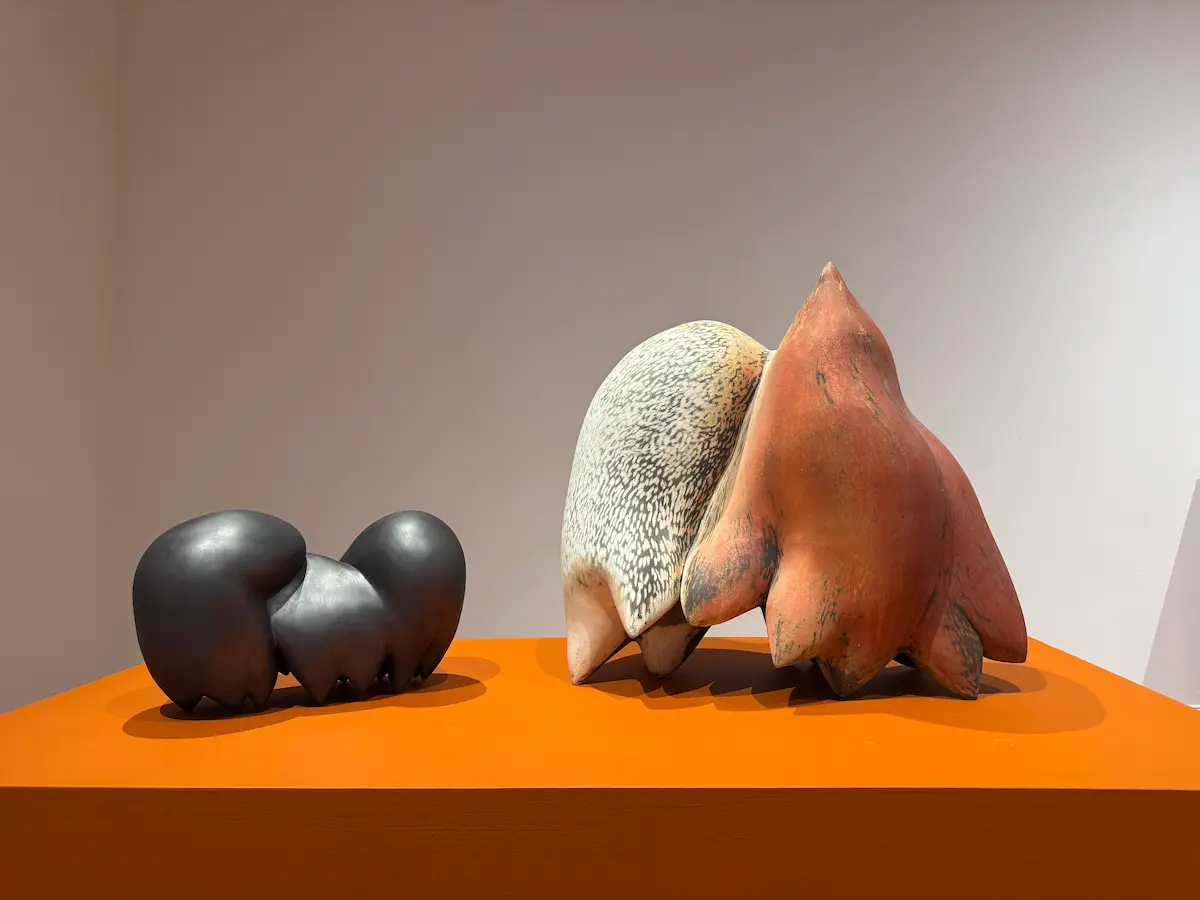
Installation view of "Planting in Place, Time, and Memory". Courtesy Woodmere, Philadelpha.
With so much uncertainty, there is something comforting – perhaps even preferential – to the notion of life defined by a steady incline, as opposed to a rapid ascent (and what likely follows). Few can state, unequivocally, to have achieved self-acceptance and respect in their life and career; fewer still can say that the timing for each has been just right. The Pittsburgh-born, Philadelphia-based multimedia sculptor Syd Carpenter, however, can, and does, claim both. From January 24 – May 24, 2026, Woodmere in Philadelphia – alongside other venues such as the Frances M. Maguire Museum at St. Joseph's University, and the Berman Museum of Art at Ursinus College – hosts a retrospective of an artist whose career spans over five decades, and is defined by constant exploration, experimentation and reinvention.
Beginning her art practice in the 1970s at the Tyler School for Architecture with a brush in hand, Carpenter soon pivoted to constructing three-dimensional shapes in her chosen medium of clay. Drawn immediately to sculpture’s intimate relationship with the human body, Carpenter shared: “It's tactile when I'm making [a sculpture]... then I realize that once it gets shown [in a gallery or museum], it no longer becomes tactile.” Within the hierarchy of media in the Euro-American museum context, sculpture occupies a privileged position, albeit with radical potential. Like textiles, it conjures up a core human emotion: the desire to connect through the act of touch. Sculpture, unlike painting, demands engagement first through the tangible, a central feature of the medium so often left unexplored due to rules and regulations regarding artworks in museum galleries. Once a sculpture is placed on a pedestal or mounted onto a wall, it immediately becomes at odds with the ethos of the artist’s practice; within the context of the museum, the work, now in-situ, is in direct conflict with the educational prerogative of accessibility.
Part of the role of the artist, therefore, is coming to terms with the literal and figurative position of sculpture within art museum infrastructure. Uninterested in the art historical discourse regarding the separation between “craft” and “fine art” – a distinction that, with the fluidity of contemporary art today, appears increasingly without a difference – Carpenter employs the medium at its most capacious, working with materials used by “traditional” ceramicists, as well as soil, vegetation, wood and stones found in nature. In every project or series, her sculptures connect to the histories of forced and gendered labor, agriculture and rural geography, and narratives of enslavement and displacement. More than a decade ago, Carpenter traveled across the American South to meet multi-generational African American farmers living and working on land occupied by their enslaved ancestors. Creating the series Places of Our Own, Carpenter titled several sculptures with the names of the owners of those farms, often collecting soil directly from the sites, and choosing various shades of brown to represent the skin of the farmers she encountered. Carpenter recalled the impetus for her trip in 2012, stating: “...I found a book [by an] anthropologist [by] the name of Richard Westmacott. And he did a book titled [African-American Gardens: Yards in the Rural South]… he looked at the destroyed tree farms and he described them in terms of what was there, what did he see… The actual gardens themselves…were tilled and you could see that they had been…farms. Each one would have a barn or have a shed or would have a fence. He mapped out all of those details of each one and created these maps which he included in the book. And I looked at the book and decided I would take those maps and reinterpret them sculpturally…so it wasn't about trying to make a model. I wasn't trying to replicate his map. [When] I started, I would take clues and little signals from them and turn them into sculptural depictions, improvised, of course…”
.webp)
Albert and Elbert Howard, 2014, Clay, steel, graphite, 49 x 42 x 27 in. Courtesy of the Petrucci Family Foundation
Collection of African American Art
In Carpenter’s oeuvre, certain iconographic markers persist: again and again, she returns to the symbol of the bowl, the miniature barn, the ginko leaf, and what she refers to as the “mother pin.” Consistently visible across her practice over the last twenty years, her “mother pins” are enlarged sculptural clothespins – some of which are over six feet in height – modeled after the vintage wooden types she recalls seeing her mother use when drying clothes in their backyard. Carpenter reminds us that whenever we, as visitors, see a “mother pin,” we should be imagining her mother, who was an artist in every way but name: “...[T]he clothespin is derived from the fact that I still have a bag of vintage clothespins that [my mother] used to hang my clothes on in the backyard. And so I've been doing this series of sculptures…that use this vintage wooden clothespin to represent her in these different guises and identities…. And those three objects are iconic in the series. Whenever you see them – the bowl, the house, the clothespin – you know we're talking about my mother.”
Loose soil from rural farmland. The names of Black farmers living in homesteads across the American South. Carved and shaved wooden blocks, or secondhand wooden fasteners, in different colored browns. Everything Carpenter uses in her practice has a clear and present lineage; she employs materials and illustrates stories impacted by time and place, as well as current and changing environmental conditions. Combining the new with the old, the quotidian with the personal, Carpenter narrativizes Black American lives – which directly challenge the dominant (re)telling of the history of this country – through intimate and regional microhistories. And over time, larger and wider audiences have begun to listen through small monographic exhibitions, group shows, individual acquisitions and now a multi-venue retrospective in the city she calls home.
In many ways, Carpenter’s career mirrors trends across the art world. Over the last decade, growing numbers of contemporary Black artists have been catapulted into the mainstream art world, leading to record-shattering prices at auction houses and endless waitlists for eager collectors hoping to find the next “one.” As museums increasingly undertake reparatory work to address “gaps” in their permanent collections, historic Black artists have also received new recognition; this, too, is reflected in the prices achieved for their works on the secondary market. In 2020, the art world “reckoned” briefly with racism primarily through an explosion in the purchase of Black (typically figurative) art by celebrity collectors, private foundations and other established arts organizations, as well as the introduction of or renewed support for professional opportunities centering on supporting Black art professionals. Still, the fundamental aspects of the art world – exclusivity, exoticization of artists of marginalized identities and elitism – remained unchanged, and much of the money directed towards Black artists has all but dried up.
And yet: “I wouldn’t really change much of anything,” Carpenter stated early into our conversation in the one of the Woodmere galleries, surrounded by her latest works, such as the mixed-media standing assemblages Albert and Elbert Howard (2014) and Sarah Reynolds (2014), named after famous Civil Rights activists and women she encountered on her roadtrip across the American South. “So I feel as if even though it's [my career] low and under the radar, I feel like I really had a good life as an artist and continue to do so.” With long standing support from her peers, museums, the state and national funding bodies, the point of it all for Carpenter is clear: “I feel that life is short. And in that lifetime, substance and meaning and connection have to be a part of it… As an artist, [I] spen[t] my early years wondering what my art was going to be… I wanted to be in a place where, ‘okay, I don't care what they think.’ You know, I'm going to be under the radar forever, anyway. So let's just… get to a point where I had courage... Because courage is so, it's so much a part of this.”